Moscow-Brest Railway
Doctor ZhivagoThe Moscow-Brest Railway is more than a route across the city: it is a densely worked industrial world where labor, official indifference, political organization, and private lives meet. Its engine depots and freight yards frame the 1905 strike, while later references to railway space show how revolution changes the uses of homes and the meaning of departure. The line’s story moves from the daily handling of trains and wages to a stoppage that workers experience as both a practical action and a threshold in history.
Industrial Setting and Labor
Near the corner of Tverskaia Street, the workshop stood in a one-story house beside the Brest railway. Engine depots, warehouses, and railway employees’ lodgings made up the surrounding landscape. The railway was not an abstract line on a map but a neighborhood and workplace, with ordinary social ties reaching between the freight yard and the people who lived nearby. Olia Demina, a quick apprentice at Madame Guishar’s workshop, lived in one of the railway lodgings; her uncle worked in the freight yard. Her affection for Lara Guishar links the industrial district to the domestic and commercial life of the story.
That autumn, unrest was already spreading across the Moscow railway network. Workers on the Moscow-Kazan line had struck, and the men on the Moscow-Brest line were expected to follow. The strike decision had been made, but the committee still debated its timing. The uncertainty did not mean that the railway was calm: everyone knew a stoppage was coming, and only a pretext was needed to set it in motion.
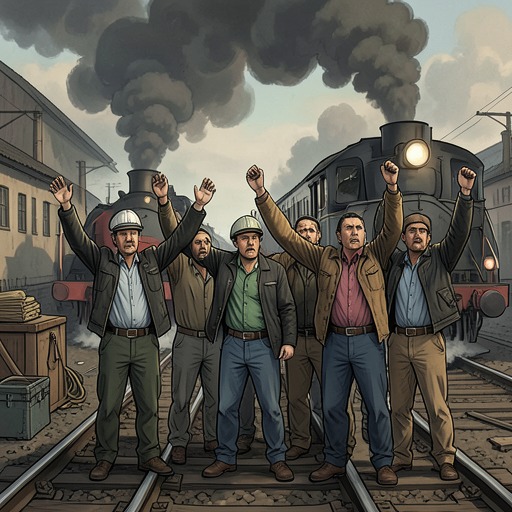
The day wages were due, on a cold, overcast morning at the beginning of October, workers and supervisors moved through a setting that the narration renders in material detail. Conductors, switchmen, mechanics, assistants, and depot scrubwomen crossed the ground between the management buildings and the station, its workshops, warehouses, engine sheds, and tracks. Trains were shunted and coupled as signals, horns, and whistles sounded; smoke and boiling steam rose over the railway. This busy routine supplies the physical order that the impending strike will interrupt.
Neglect and the Coming Strike
The railway’s conflict is sharpened by a dispute over safety and responsibility. Fuflygin, the Divisional Manager, and Pavel Ferapontovich Antipov, the Track Overseer for the station area, walked beside the tracks while Antipov pressed his complaints about the spare parts used in repairs. The steel was insufficiently tensile, and the rails failed the strain test. Antipov feared they would crack in frosty weather, but management shelved his warnings; the narrative suggests that someone profited from the contracts.
Their walk exposes a divide between technical responsibility and managerial self-interest. Antipov attends to the material weakness of the track and the danger it may create. Fuflygin, dressed in an expensive fur coat with railway-uniform piping over a new civilian suit, is preoccupied with his appearance and the time. When Antipov’s concerns reach him, he dismisses them by contrasting the busy main lines with sidings and dead ends he considers unimportant. His contemptuous answer reduces the risk to a question of traffic volume, while the defective rails and the likelihood of frost remain real.
The strike itself develops through a related but distinct sequence. The committee settles on beginning it that night after Kuprian Savelievich Tiverzin has left an underground shelter with Antipov. The decision-makers assign where each participant should go and which men should be called out. When the engine repair shop’s whistle sounds, the signal seems to Tiverzin to rise from the depths of his own soul. A crowd is already moving out from the depot and freight yard; the boiler-room men join after downing tools at his signal.
At first, people emerging from the buildings ask where everyone is going and what the signal means. Some are told that there is a fire and an alarm; another voice identifies the stoppage as a strike and urges the men not to do the employers’ work for them. As more workers join the moving crowd, the uncertainty gives way to collective action: the railway workers are on strike. The sequence makes the work stoppage visible not as one man’s isolated gesture but as a gathering movement through the railway’s interconnected workplaces.
Tiverzin and the Strike’s Meaning
Tiverzin initially misunderstands the full organization of the event. As he hurries away with his thoughts racing ahead of him, he sees the recent troubles on the line, meetings, speeches, and the decision to strike as separate stages on a larger road toward a more rational and harmonious world. Yet he does not know that the committee has already decided to start that very night. The discrepancy between his sense of personal initiative and the committee’s prior coordination becomes part of the strike’s later history.
For years, Tiverzin believes that he alone stopped work and traffic on the line that night. Only much later, at his trial, when he is charged with complicity in the strike but not with inciting it, does he learn what the committee had decided after he left. The revelation revises his memory without erasing his action: he did signal the boiler-room workers, but the strike’s plan and division of tasks had been made independently of his departure. The railway’s history is thus shown to exceed the recollection of any single participant.
Two days after the stoppage, Tiverzin returns home unshaven, drawn from lack of sleep, and chilled after an unusual frost for which he was not dressed. His mother greets him in tears. He reassures her that the line has been struck from Moscow to Warsaw, while she fears that he will be pursued and urges him to get away. The breadth of the stoppage, expressed through the line’s reach, turns a railway report into a family danger: public action follows him across the threshold of home.
Railway Space After Revolution
Later, the railway’s familiar vocabulary is absorbed into a changed social order. When Yurii Andreievich Zhivago returns to his family home, Antonina Alexandrovna Gromeko explains that part of the ground floor has been offered to the Agricultural Academy because the house is too large to heat. The institution has brought in libraries, herbariums, and seed specimens, and the family now calls the rooms living space. Yurii compares this altered household to a private house used as a hospital, recalling the superfluous furnishings and rooms that once surrounded the wounded. A railway-adjacent industrial setting has given way to a home being reorganized for collective use; the changed name for rooms makes the political transformation audible in ordinary conversation.
The same process appears in the proposed Tiverzin Hostel. At a meeting, a speaker argues that a large house should accommodate delegates who come to town for conferences and announces that it will be taken over as a district soviet hostel, named for Tiverzin, who lived there before being deported. Working people are to be rehoused, while others are given a year to find accommodation. The announcement turns a former residence into assigned institutional space and converts Tiverzin’s past connection with the house into an official memorial. The crowd’s insistence that everyone present is a worker, and the interruption alleging Great-Russian chauvinism, reveal how housing allocation becomes a struggle over both material claims and political identity.
When the Zhivago family’s train reaches the provinces, it is still on a siding behind other trains that screen it from the station. The family feels that its connection with Moscow, until then unbroken, has snapped. The railway does not simply carry them away: its siding marks the moment when a familiar center gives way to another territory with its own provincial world. The transition from the strike-bound Moscow network to this arrival recasts railway space as a boundary between social worlds.
In Yuriatin, Larisa Feodorovna explains that she and Katenka no longer live in the school building, which the Town Housing Department has taken over. They have been given part of another house, whose owners left behind so much furniture that she has shut it away in two dark rooms and whitewashed the windows. Her account makes the new housing order concrete: institutional appropriation determines where she can live, while her own route through the cluttered rooms becomes a small act of practical adaptation. The older railway setting and the later domestic scenes belong to the same history of spaces being reorganized under changing authority.
That history returns to an abandoned railway-associated world when Yurii and Larisa arrive at the Mikulitsyns’ house. Finding its door padlocked, Yurii tears the lock away with its screws and splintered wood, and they hurry inside without removing their coats, hats, or felt boots. Some rooms, especially the study, are unexpectedly tidy, though the rest of the house raises questions about recent occupants and flight. Rather than solve the mystery, they suppose that a White officer may have been hiding there and decide they will make arrangements if he appears. The contrast between the broken lock and the preserved study makes a private room seem briefly recoverable: Yurii is once again struck by the spacious, convenient table beside the window and imagines the conditions for patient work.
Narrative Significance
Across these episodes, the railway links labor and movement to the changing organization of everyday space. In the strike scene, its tracks, depots, and signals are the practical means by which separate groups of workers become a crowd. The defective rails and shelved complaints show how material neglect lies beneath political unrest; the later trial reveals that collective action also exceeds an individual participant’s understanding of it.
The railway’s significance changes with the novel’s historical movement. It first locates a community of employees, families, and workplaces; it then carries a stoppage that reaches from Moscow toward Warsaw and makes Tiverzin’s participation dangerous at home. Later trains mark the Zhivago family’s separation from Moscow, while homes and rooms are reassigned to institutions, hostels, and new occupants. The line therefore binds together two transformations: workers interrupting the established traffic of the railway, and revolution reshaping the spaces in which people live and travel.